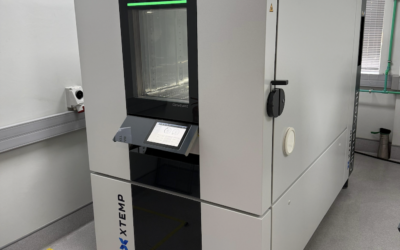
Environmental simulation plays a crucial role in ensuring product reliability and performance across diverse sectors. The EXCAL 3 represents a leap forward in environmental test chambers, offering unparalleled precision, efficiency, and a commitment to sustainability.
The R744 (CO2) Advantage: Performance and Sustainability
The EXCAL 3 utilizes R744 (CO2), a natural refrigerant with a Global Warming Potential (GWP) of 1, minimizing environmental impact. Its thermodynamic properties enable efficient and reliable performance:
- Cooling Performance: Achieves efficient testing down to -50°C. Cascade version available for applications below -50°C.
- Minimal Gas Charge: Innovative design minimizes gas charge, eliminating mandatory annual leak checks.
- Sustainability: Contributes to a reduced carbon footprint.
Core Technical Specifications
- Temperature Range: (-50°C to +180°C standard). Optional extensions to +200°C
- Humidity Range (Humidity Model): 5% to 98% RH (for temperatures from +10°C to +90°C).
- Transition Speeds: 2°C/min to 20°C/min.
- Homogeneity: +/- 0.4°C to +/- 1.5°C.
- Temperature Regulation Stability: +/- 0.1°C to +/- 0.3°C.
- Humidity Regulation Stability: +/- 2%.
- Internal Volume Options: 151L, 227L, 400L, 540L, 770L, 1000L, 1400L, 1800L.
Key Features & Technologies

- Spirale Vision Software: Intuitive and comprehensive control software for chamber management.
- Test Manager: Accurate and easy traceability.
- Program Editor: Loops, On/Off, “Wait-for” commands, graphical profile creation.
- Remote Control: Web server allows remote equipment status checks via internet browser.
- Supervision: Manage multiple chambers from a single workstation.
- Energy Saving Control: Reduces electrical consumption by at least 40% on typical cycles. Reduces water consumption.
- Ergonomic Design:
- Fully open door for easy access.
- Portholes (Ø 100 mm standard).
- 304L stainless steel test space.
- Aeraulic System: Optimized air circulation with double flow ventilation for temperature uniformity.
Power and Control
- User Interface Panel (UIP): Centralized connections, including a safety socket (optional), status indicators, and configurable dry contacts.
- Power Supply: 400V three-phase 50 Hz/60 Hz
- Cooling: Air-cooled or water-cooled condenser options.
Options & Customization
- Additional Portholes: Various sizes and locations (sides, ceiling, door, window).
- Specific Connectors/Sensors: Adapted to customer requirements.
- Data Acquisition: PT100, thermocouples, additional units.
- Relay Outputs/Logical Inputs: 6 relay outputs / 6 logical inputs.
- Specific Digital Communication: IEEE 488, 0/10v analogue control.
- Air Dryer: For preventing humidity formation.
- 316L Stainless Steel Cabinet: For protection against chemical hazards.

The Importance of CO2 as a Refrigerant:
There’s a growing global consensus emphasizing the need to transition away from refrigerants with high Global Warming Potential (GWP) due to their significant contribution to climate change. CO2 emerges as a key alternative and a crucial component for a sustainable future for several reasons:
- Extremely Low GWP: With a GWP of 1, CO2 has a negligible impact on global warming compared to many synthetic refrigerants (HFCs) that have GWPs hundreds or thousands of times higher. This is the primary driver for its importance.
- Natural Substance: CO2 is a naturally occurring substance, unlike many synthetic refrigerants. This generally makes it more environmentally benign in terms of its lifecycle, production, and disposal.
- Regulatory Compliance: Government regulations and international agreements (like the Kigali Amendment to the Montreal Protocol) are increasingly phasing down the use of high-GWP refrigerants. Adopting CO2-based systems allows companies to stay ahead of these regulations and avoid future compliance issues. Using CO2 demonstrates a commitment to environmental responsibility.
- Long-Term Solution: Because it’s a natural substance with a GWP of 1, CO2 is seen as a long-term and sustainable solution, not a temporary fix that might be replaced by another refrigerant in the future.
- Energy Efficiency Gains: While early CO2 systems had some energy efficiency challenges, advancements in technology are improving their performance. In some applications, CO2 systems can achieve comparable or even superior energy efficiency compared to traditional systems, especially in heat pump applications.
- Availability: CO2 is widely available, relatively inexpensive, and easy to produce.
Why This Matters for the EXCAL 3 and Environmental Simulation
For environmental simulation, the shift to CO2 refrigerant like in the EXCAL 3 is especially important:
- Demonstrates Environmental Responsibility: Companies using environmental test chambers are often working on developing more sustainable products. Using a CO2-based chamber aligns with their overall environmental goals.
- Avoids Future Retrofits: By investing in CO2-based equipment now, companies avoid the need for costly retrofits or replacements in the future as high-GWP refrigerants are phased out.