MIL-STD-810H is the United States Department of Defense’s standard for environmental engineering considerations and laboratory testing. For South African engineers qualifying products for defence, aerospace, satellite, automotive, and telecommunications applications, it is one of the most frequently specified and technically demanding standards in the field. This guide covers the six most critical environmental test methods in detail — temperature, humidity, altitude, solar radiation, sand and dust, and rain.
What Is MIL-STD-810H?
MIL-STD-810 is a US Department of Defense test method standard that has been in continuous development since 1962. The current version — MIL-STD-810H — was released in 2019 and updated with Change Notice 1 in 2022. It replaced MIL-STD-810G, which had been the reference version since 2008.
The standard does not define a single test that products must pass. Instead, it provides a library of 28 individual test methods — each targeting a specific environmental stress — that programme engineers and test planners draw from to build a tailored qualification programme appropriate for a product’s intended deployment environment.
The key philosophy of MIL-STD-810H is tailoring. The standard explicitly states that selecting appropriate methods, procedures, and parameter levels must be based on the product’s specific life cycle environmental profile — the actual conditions it will experience during manufacture, transport, storage, deployment, and operation. A radio mounted in a desert vehicle faces different stresses to a sensor deployed at altitude on an aircraft. The tailoring process ensures the test programme reflects the real threat, not a generic worst case.
For South African engineers, MIL-STD-810H is relevant across a wide range of sectors: defence equipment supplied to the SANDF or export customers, aerospace and satellite components, rugged electronics for mining and industrial applications, automotive systems for harsh environments, and telecommunications infrastructure exposed to outdoor conditions.
The full list of MIL-STD-810H test methods covers temperature, humidity, altitude, solar radiation, rain, sand and dust, salt fog, fungus, immersion, vibration, shock, acoustic noise, acceleration, and more. This guide focuses on the six climatic methods most commonly encountered in practice and most relevant to XTEMP’s environmental test chamber range.
Method 501.7 / 502.7 / 503.7 — Temperature Testing

Temperature is the most universally applicable environmental stress in MIL-STD-810H, and three distinct methods address different aspects of thermal exposure.
Method 501.7 — High Temperature
Purpose: To evaluate the effects of high temperature conditions on material safety, integrity, and performance — both during storage and in operation.
High temperature testing is relevant to any equipment that may be deployed in hot environments: desert operations, equatorial climates, vehicle engine bays, electronic equipment racks, or any situation where ambient or induced heat exceeds standard conditions.
Three procedures are defined:
Procedure I — Storage tests how high temperatures affect a product that is not operating. The test item is placed in a chamber set to the required temperature and held until stabilised. The standard specifies a minimum of seven 24-hour cyclic cycles for storage testing, coinciding with the 1% frequency of occurrence of the most extreme temperatures at the most severe global locations. Cyclic testing follows a diurnal profile — a 24-hour temperature curve that replicates the natural daily temperature rise and fall in hot climates.
Procedure II — Operation assesses the product while it is powered and functioning. The test item is operated under its normal power load at the specified temperature until stabilised, then monitored for degradation or failure. For constant temperature exposure, the test temperature is maintained for a minimum of two hours following thermal stabilisation of the test item itself — not the chamber air. This distinction matters: dense or thermally massive items may take significantly longer to stabilise than the chamber.
Procedure III — Tactical-Standby to Operational addresses a scenario unique to military equipment: a system that has been soaking in high heat (switched off) is suddenly required to operate. This procedure tests whether a product can transition from a hot-soaked standby state to full operational performance within a specified time — a requirement for rapid-deployment military systems.
Temperature levels in Method 501.7 range from Basic Hot (43°C) to Hot Dry (49°C) for standard deployments, though customer specifications often drive requirements to 60°C, 70°C, or higher for specific applications.
Method 502.7 — Low Temperature
Purpose: To evaluate the effects of low temperature conditions on material safety, integrity, and performance during storage, operation, and manipulation.
Three procedures mirror Method 501.7:
Procedure I — Storage assesses the product in its unpowered state at low temperatures. Materials that become brittle, adhesives that crack, lubricants that thicken, and seals that harden are all targeted by this procedure. For non-safety-critical materials, the minimum soak duration at the test temperature is 4 hours following stabilisation. For rubber, plastics, and materials known to degrade progressively at low temperatures, the standard recommends a minimum of 72 hours — recognising that some failure modes are time-dependent and will not manifest in a shorter test.
Procedure II — Operation tests the product while it is powered at low temperatures. Cold starting behaviour, performance degradation, display readability in cold conditions, and electrical connector reliability at low temperature are all assessed.
Procedure III — Manipulation is unique to Method 502.7 and has no equivalent in the high temperature method. It assesses whether personnel wearing heavy cold-weather clothing and gloves can assemble, operate, and disassemble the equipment. This procedure recognises that military equipment is often operated by personnel in full arctic or extreme cold weather gear, and that controls, connectors, and switches must be operable in those conditions.
Low temperature test levels range from Basic Cold (-21°C) to Severe Cold (-51°C) in the standard, though equipment specified for arctic deployment or high-altitude operation may be tested to -65°C or lower.
Method 503.7 — Temperature Thermal Shock

Purpose: To evaluate the ability of a product to withstand sudden, extreme changes in ambient temperature — and to determine the structural and functional effects of these rapid transitions.
Temperature shock testing is distinct from high and low temperature testing in that the rate of change is the primary stress, not the absolute temperature. The standard targets failure modes caused by differential thermal expansion between dissimilar materials — solder joint cracking, delamination of circuit boards, seal failure, optical element distortion, and housing fracture.
Two procedures are defined:
Procedure I — One-Chamber uses a single climatic chamber that transitions the air temperature rapidly between the hot and low extremes. Transfer times and temperature change rates are defined by the test plan.
Procedure II — Two-Chamber transfers the test item physically between a hot chamber and a cold chamber, achieving near-instantaneous exposure transitions. This procedure is more severe than Procedure I because the temperature change experienced by the test item’s surface is limited only by its thermal mass, not by the chamber’s ramp rate.
Transfer times are typically specified at less than 5 minutes to maintain the shock effect. The number of cycles required is defined by the test plan based on the product’s life cycle profile.
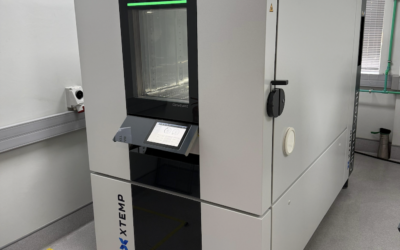
Chamber requirements for temperature testing: Methods 501.7, 502.7, and 503.7 require a precision climatic chamber with sufficient temperature range, adequate heating and cooling capacity to achieve specified ramp rates under load, and a well-tuned control system capable of maintaining the ±2°C temperature accuracy the standard requires. The Climats EXCAL Chamber — available from XTEMP in sizes from 180 to 2,000 litres — covers the full MIL-STD-810H temperature range for Methods 501 and 502, with temperature change rates up to 5K/min for Method 503 Procedure I applications.
Method 507.6 — Humidity
Purpose: To evaluate the effects of a warm, humid atmosphere on material integrity and performance — including condensation effects, corrosion initiation, and degradation of electrical insulation.
Humidity is one of the most pervasive and damaging environmental stresses for electronics and mechanical systems. Moisture ingress causes corrosion of metallic contacts and conductors, swelling and delamination of composite materials, degradation of lubricants, reduction of electrical insulation resistance, and biological growth on organic materials. For military equipment that may be deployed in tropical or maritime environments, or subjected to condensation cycles during transit between temperature extremes, Method 507.6 is a critical qualification gate.
Two procedures are defined:
Procedure I — Natural Cycle replicates realistic hot and humid conditions using a 24-hour temperature and humidity profile derived from real-world meteorological data. The recommended test duration of 45 days represents the 99th percentile of the longest continuous streak of humid days observed at tropical deployment locations — ensuring that the test represents the most demanding natural exposure a product is likely to encounter. Performance checks are conducted at least once every five days during the test.
The daily cycle reaches a peak of approximately +38°C and 95% RH during the humid portion, dropping to lower humidity during the simulated night phase. The cycling nature of the test replicates the condensation and drying cycles that are more damaging than steady-state humidity exposure.
Procedure II — Aggravated Cycle accelerates the test using a more severe combination than occurs naturally: +60°C and 95% relative humidity simultaneously. This combination does not occur in nature, but it compresses the exposure into a shorter test programme. The minimum number of 24-hour cycles for the aggravated procedure is ten, with a conditioning cycle preceding the test cycles. Procedure II is used when test schedule constraints make the 45-day Procedure I impractical, and when the customer accepts an accelerated test as equivalent evidence of compliance.
Failure modes targeted: Surface corrosion of metallic components and connectors, degradation of conformal coatings on PCBs, swelling of polymer housings affecting mechanical fit, loss of optical clarity in windows and lenses, reduction of electrical insulation resistance below specified limits, and initiation of fungal growth on organic materials (which is then evaluated under the separate Method 508.8 Fungus test).
Chamber requirements: Procedure I and II require a chamber with precise humidity control at elevated temperatures. The combination of +60°C and 95% RH in Procedure II is particularly demanding on the humidification system. The Climats Excal Test Chamber absolute humidity control system is specifically engineered for this kind of demanding multi-variable control, maintaining the ±5% RH accuracy required by the standard across the full temperature and humidity range.
Method 500.6 — Low Pressure (Altitude)

Purpose: To determine whether a product can withstand and operate correctly in low pressure environments — including high ground elevations, air transport, and rapid decompression events — without suffering structural failure, performance degradation, or safety hazards.
As altitude increases, atmospheric pressure decreases. At 3,000m above sea level, pressure has fallen to approximately 70 kPa (70% of sea level). At 12,000m — the pressurised cabin altitude of a transport aircraft — it has dropped to approximately 20 kPa. Equipment sealed at sea level experiences increasing differential pressure as altitude rises, placing seals, housings, and pressure-sensitive components under stress. Gases dissolved in fluids or trapped in voids can expand and evolve. Battery cells can experience case deformation. Cooling systems dependent on convective air heat transfer lose efficiency as air density decreases.
Three procedures are defined:
Procedure I — Storage and Air Transport is appropriate for equipment that will be transported or stored at high elevation or in unpressurised aircraft cargo holds. The test item is placed in an altitude (low pressure) chamber and the pressure is reduced to correspond to the specified test altitude — typically between 4,600m (equivalent to 57 kPa) for ground storage in highland regions, and 12,200m (21 kPa) for air transport in the unpressurised hold of a military transport aircraft. The standard requires a minimum hold of one hour at the test pressure unless the test plan specifies otherwise.
Procedure II — Operation at Altitude determines equipment performance under operating conditions at reduced pressure. The test item is powered and monitored while the chamber is held at the specified altitude pressure. This procedure targets cooling system performance degradation, arcing risks in high-voltage equipment at reduced pressure (where corona discharge thresholds drop), and seal and connector leakage under differential pressure.
Procedure III — Rapid Decompression tests whether a sudden, large pressure decrease causes the test item to react in a way that could endanger personnel or the platform. This procedure is specifically relevant to equipment installed in aircraft cabins or pressurised vehicle compartments that may undergo rapid decompression in emergency or battle damage scenarios. The test determines whether the sudden pressure drop causes explosive venting, flammable gas release, or mechanical failure that poses a secondary hazard.
Temperature rate of change during altitude testing must not exceed 3°C/min to avoid introducing thermal shock effects that are not part of the altitude method’s intent.
Chamber requirements: Method 500.6 requires an altitude (vacuum) chamber capable of reducing and holding pressure to the required test altitude. Temperature control during the test is specified separately in the test plan. XTEMP supplies altitude and vacuum chambers capable of simulating altitudes up to and beyond 12,000m, with integrated temperature control for combined altitude and temperature testing.
Method 505.7 — Solar Radiation (Sunshine)

Purpose: To evaluate the effects of solar radiation on materials and equipment — both the heating effects of solar energy absorbed by the product’s exterior, and the actinic effects of ultraviolet radiation causing photochemical degradation of materials.
Solar radiation testing is distinct from high temperature testing. Where Method 501.7 uses a climatic chamber to raise the air temperature around the product, Method 505.7 subjects the product’s surface directly to simulated solar radiation. The surface temperature achieved during solar testing can be significantly higher than the ambient air temperature — replicating the conditions of a product left in direct sunlight in a hot climate, where surface temperatures of dark-coloured materials can exceed ambient air temperature by 30°C or more.
Two procedures are defined:
Procedure I — Cycling (Diurnal) simulates a realistic daily solar cycle. The radiation intensity is varied across a 24-hour profile in half-hour steps, rising from zero at dawn, reaching a peak of 1,120 W/m² at solar noon, then declining to zero at dusk. The chamber temperature follows a corresponding profile. Each cycle represents one day of solar exposure. The standard requires a minimum of three complete cycles (three days of simulated solar exposure) for the test to be valid.
Procedure II — Steady State subjects the product to a constant, maximum-intensity solar radiation until thermal equilibrium is reached, then maintains the condition for the required duration. This procedure is used when only the heating effect at peak solar load is of concern, rather than the cumulative actinic (UV) degradation over time.
What solar radiation testing reveals:
The heating effects cause: jamming or seizure of moving parts whose clearances were designed for ambient temperature; weakening of solder joints and adhesive bonds as different materials expand at different rates; softening of potting compounds and casting resins; degradation of rubber seals and gaskets; and overheating of electronic components housed in dark enclosures that absorb solar energy.
The actinic effects of ultraviolet radiation cause: fading and chalking of paint and plastic surfaces; embrittlement and cracking of rubber, plastic, and polymer materials; loss of transparency in optical windows and lenses; and degradation of protective coatings and conformal coatings on printed circuit boards.
Test facility requirements: Method 505.7 requires a solar simulation chamber equipped with lamps providing a spectral distribution matching natural sunlight (typically xenon arc or filtered metal halide lamps). The standard requires verification of spectral distribution, intensity, and uniformity at intervals not exceeding 500 hours of operation, and a full check of overall intensity and uniformity before and after every test. XTEMP supplies solar simulation chambers capable of meeting these requirements, appropriate for defence, aerospace, automotive exterior, and outdoor telecommunications equipment qualification.
Method 510.7 — Sand and Dust

Purpose: To evaluate the ability of a product to resist the effects of fine airborne dust particles and windblown sand — and to determine whether penetration of dust or sand into the product degrades its performance, safety, or operational life.
Sand and dust testing is essential for any equipment deployed in arid environments — desert operations, open-cast mining sites, airfields, unpaved roads, and any outdoor location subject to dusty conditions. Dust penetrating through seals and bearings causes abrasive wear. Sand particles can score optical surfaces, clog filters, jam moving mechanisms, and short-circuit electrical contacts. Fine settling dust can accumulate on PCBs and electronic components over time, trapping moisture and initiating corrosion.
Two procedures are defined:
Procedure I — Blowing Dust uses fine airborne dust particles (typically Arizona Road Dust, ISO Medium Test Dust, or equivalent) propelled at the test item by controlled airflow. The dust concentration and airspeed are specified in the test plan. This procedure targets the penetration of fine particles through seals, gaskets, ventilation paths, and connector interfaces during exposure to a dusty operating environment.
Procedure II — Blowing Sand uses larger sand particles at higher concentrations and airspeed, replicating the conditions encountered in sandstorm events or helicopter downwash. This procedure is more aggressive than Procedure I and targets abrasion damage to surfaces, lenses, and coatings in addition to penetration.
Test execution — key procedural requirements:
The standard specifies that after completing the dust or sand exposure, the air speed is reduced to no greater than 2.5 m/s before the dust feed is stopped. The test item must then be allowed to return to standard ambient conditions at a rate not exceeding 3°C/min. After the dust has settled — which the standard acknowledges may take up to one hour — the test item is photographed to document dust accumulation before any cleaning.
A critical procedural note: accumulated dust must be removed by brushing or wiping only — not by air blast or vacuum cleaning — unless these methods are actually used in service. This prevents the test from artificially removing dust that would remain in the real operational environment and could cause delayed degradation.
Inspection after dust removal focuses on bearings, seals, lubricants, filters, vents, and electrical contacts — the locations most susceptible to dust-induced damage.
Interaction with other methods: The standard notes that dust exposure can influence results from subsequent solar, humidity, fungus, and salt fog tests, as dust residue changes the surface characteristics of the test item. The sequence in which dust testing is performed within a broader test programme therefore requires engineering judgement.
Chamber requirements: Method 510.7 requires a dedicated sand and dust test chamber with controlled airflow, particle feed system, and appropriate dust containment. The Weiss Technik DustEvent chamber — available through XTEMP — is designed specifically for IP5X and IP6X dust ingress testing to IEC 60529, and can be configured for MIL-STD-810H Method 510.7 blowing dust exposure.
Method 506.6 — Rain

Purpose: To evaluate whether a product can withstand exposure to rain, blowing rain, or dripping water without suffering damage to seals, covers, cases, or internal components — and to confirm that the product continues to function correctly during and after rain exposure.
Rain testing is relevant to any product that will be used or transported in outdoor environments. Water ingress through inadequate sealing causes corrosion, short circuits, and degradation of insulation. Blowing rain exposes interface joints, connector faces, and gasket interfaces to water at pressure, revealing seal designs that are adequate in still conditions but fail under wind-driven impingement.
Three procedures are defined:
Procedure I — Rain and Blowing Rain simulates natural rain and wind-driven rain conditions. The test item is exposed to a rainfall rate of approximately 1.7 mm/min with controlled wind speed creating the blowing rain effect. This procedure subjects the product’s seals, connectors, joints, and covers to the conditions expected during operation in field rain events. The test is performed with the product in its operational configuration — covers closed, connectors mated, antennas deployed — to test the assembly as it would be used.
Procedure II — Exaggerated applies higher rainfall rates and higher wind speeds than Procedure I, representing conditions more severe than typical natural rain events. This procedure is used when the standard rain procedure cannot be applied due to the size or configuration of the test item, or when the product specification calls for a more severe rain resistance demonstration. It is also used when Procedure I facilities are not available and an equivalent level of water ingress stress must be demonstrated.
Procedure III — Drip simulates water falling vertically onto the product — replicating condensation dripping from overhead surfaces, water entering vehicle compartments, or rain falling on equipment in a sheltered but not fully weatherproof location. This procedure uses a much lower water flow rate than Procedures I and II and is specifically aimed at evaluating the resistance of equipment to slow, steady drip exposure rather than active rain.
Limitations of Method 506.6: The standard explicitly notes that this method does not include procedures for rain erosion testing — the abrasive removal of surface material by high-velocity rain impacting the product at speed (relevant to aircraft canopies, radomes, and leading edge surfaces). Rain erosion requirements depend on specific material and velocity parameters and are addressed in product-specific specifications.
The standard also notes that Method 506.6 may be considered optional when a product has already passed the Immersion test (Method 512.6) — since successful immersion testing demonstrates a higher level of water ingress resistance than rain exposure alone.
Test Sequencing — Why Method Order Matters
MIL-STD-810H does not mandate a fixed sequence for performing multiple test methods. However, the standard explicitly recognises that test sequence affects results — and that careful engineering judgement is required.
Several important interactions exist between the methods described in this guide:
Solar before Dust: Results from Method 505.7 solar radiation testing define surface temperature levels that should be used as parameters in Method 510.7 sand and dust testing. Solar testing heats surfaces to temperatures above air temperature — dust deposited on a hot, solar-heated surface behaves differently from dust on an ambient-temperature surface.
Dust before Humidity and Salt Fog: Dust residue remaining in seals, joints, and on surfaces after Method 510.7 can exacerbate corrosion during subsequent humidity (507.6) and salt fog (509.7) testing. A programme that sequences dust before these tests represents a more realistic combined stress than testing each method in isolation on a clean specimen.
Temperature Shock before Humidity: Products with pre-existing thermal cycling micro-damage to seals and enclosures are more susceptible to moisture ingress. Testing Method 503.7 temperature shock before Method 507.6 humidity better represents the cumulative damage progression of a product in field service.
As-new versus life-cycle state: The standard recommends considering whether products should be tested in their as-new condition only, or also in a condition representative of a used or aged product. Field-returned equipment tested to MIL-STD-810H may behave differently from new units — and the programme specification should reflect this where relevant.
XTEMP — The Equipment for MIL-STD-810H Testing in South Africa
XTEMP is Southern Africa’s specialist in environmental test chambers, and our product range covers the full suite of chamber types required to perform the MIL-STD-810H methods described in this guide.
| MIL-STD-810H Method | XTEMP Equipment |
|---|---|
| 501.7 High Temperature | Climats EXCAL — available in 150–2,000L, up to +180°C |
| 502.7 Low Temperature | Climats EXCAL — CO2 refrigerant systems to -40°C; cascade systems to -70°C |
| 503.7 Temperature Shock | Thermal Shock Chamber — rapid transition between hot and cold zones |
| 507.6 Humidity | Climats EXCAL — absolute humidity control to 95% RH at +60°C |
| 500.6 Low Pressure (Altitude) | Altitude and Vacuum Chambers — to 12,000m+ equivalent |
| 505.7 Solar Radiation | Solar Simulation Chambers — 1,120 W/m² with spectrally correct radiation |
| 510.7 Sand and Dust | Weiss Technik DustEvent — IP5X/IP6X dust testing; configurable for MIL-STD-810H |
| 506.6 Rain | Rain Test Chambers — rainfall rate and wind speed controlled exposure |
All systems are supplied with full installation, commissioning, operator training, and ongoing on-site calibration support. XTEMP’s technical team can assist with test programme design, method tailoring guidance, and equipment specification for your specific qualification requirements.
We serve clients in Pretoria and Cape Town, with customers across Southern Africa in defence, aerospace, automotive, mining, electronics, and telecommunications.
Contact XTEMP to discuss your MIL-STD-810H testing requirements:
📞 Pretoria: +27 12 443 6565 📞 Cape Town: +27 21 974 6227 📧 sales@xtemp.co.za 🌐 www.xtemp.co.za