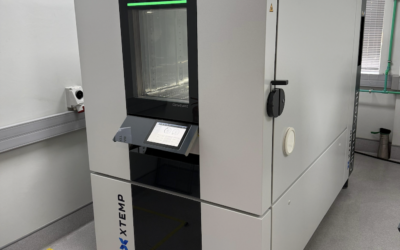
The VW PV1200 is one of the most widely specified climatic test standards in the automotive supply chain. If your facility supplies components to Volkswagen, Audi, ŠKODA, SEAT, or Porsche — or their Tier 1 suppliers — understanding how to perform this test correctly is essential to getting your parts approved.
What Is the VW PV1200 Standard?
VW PV1200 is a Volkswagen Group test specification that defines an environmental cycle test — a repeating 12-hour cycle that subjects vehicle components to alternating extremes of high temperature, high humidity, and deep cold. It is a proprietary standard developed and maintained by Volkswagen AG and applies across the VW Group’s brands.
The standard is designed primarily for components in the engine compartment and other thermally demanding locations — parts that must survive not just steady operating temperatures, but the daily and seasonal temperature swings that occur across the full life of a vehicle. Over its lifetime, a car parked in summer sun and driven through winter cold will expose its engine compartment components to hundreds or thousands of such cycles.
PV1200 simulates this accelerated exposure in the laboratory, compressing those real-world cycles into a controlled, reproducible test programme. The purpose is explicitly stated in the standard itself: to uncover component weaknesses in a short-term test with accelerated time effect — not to define the component’s requirements for continuous operation, but to reveal failure modes before they occur in the field.

What PV1200 Tests For
The standard assesses the behaviour of parts during environmental cycle stressing by means of cycling temperature and moisture. The failure modes it is designed to reveal include:
- Cracking — thermal expansion and contraction stresses cause surface cracking in plastics, rubber seals, coatings, and composite materials
- Deformation — sustained high-temperature exposure softens polymer components, causing dimensional changes that affect fit, function, or sealing
- Delamination and separation — adhesive bonds, overmoulded interfaces, and composite material layers fail under repeated thermal cycling as different materials expand and contract at different rates
- Seal and gasket failure — elastomeric seals that harden at -40°C and soften at +80°C can lose their sealing properties after repeated cycling
- Connector and contact degradation — electrical connectors in the engine compartment experience differential thermal expansion between contact pins, housings, and locking features
- Coating adhesion loss — paint, plating, and protective coatings delaminate from substrates when the bond cannot accommodate thermal cycling stresses
For South African automotive suppliers — whether manufacturing plastic trim, rubber seals, wiring harnesses, sensors, brackets, or electronic modules — PV1200 compliance is typically a gate requirement before a component can be approved for serial production supply to any VW Group customer.

The PV1200 Test Cycle — Step by Step
The test runs in repeating 12-hour cycles (720 minutes). Each cycle consists of five defined phases:
STEP 1 — Heating Phase: +23°C to +80°C with 80% RH Duration: 60 minutes
The chamber heats from ambient to +80°C while simultaneously raising relative humidity to 80%. This phase subjects the test specimen to rising thermal stress combined with elevated moisture — simulating a hot, humid summer environment. For polymers and adhesives, this phase probes softening behaviour and moisture absorption at elevated temperatures.
STEP 2 — High Temperature Soak: +80°C / 80% RH Duration: 240 minutes (4 hours)
The chamber holds at +80°C and 80% relative humidity for four hours. This sustained damp heat exposure is the most demanding phase for polymer components, adhesive bonds, and coated surfaces. It replicates the conditions inside an engine compartment on a hot day — a stationary vehicle, hot engine bay, high ambient humidity. Materials that degrade through hydrolysis, creep, or thermal softening will show their weaknesses here.
STEP 3 — Cooling Phase: +80°C to -40°C Duration: 120 minutes (2 hours)
The chamber cools from +80°C down to -40°C. As the temperature falls below 0°C, humidity control changes: at approximately 0°C, the relative humidity is regulated to 30%; below 0°C (or below +10°C depending on system capability), humidity regulation is suspended and the chamber runs dry cold. The condensation that forms on the test specimen as it crosses the dew point during cooling creates an additional wetting event — relevant for corrosion initiation on metallic components or moisture ingress at seal interfaces.
This is the most demanding phase for the climatic chamber itself. The requirement to cool from +80°C to -40°C within 120 minutes — a 120°C temperature change in two hours — demands a chamber with sufficient cooling capacity and a refrigeration system capable of reliable low-temperature operation.
STEP 4 — Low Temperature Soak: -40°C Duration: 240 minutes (4 hours)
The chamber holds at -40°C for four hours with humidity uncontrolled. This sustained deep cold exposure is the critical phase for elastomers, seals, and any material whose mechanical properties are strongly temperature-dependent. Rubber gaskets and O-rings that are flexible and compliant at room temperature can become hard and brittle at -40°C — losing their sealing function entirely. Adhesive bonds that were softened in Step 2 are now subjected to maximum thermal contraction stresses. Metals and polymers bonded together experience maximum differential contraction, placing adhesive joints under shear stress.
STEP 5 — Return to Ambient: -40°C to +23°C Duration: 60 minutes
The chamber heats from -40°C back to +23°C. As the temperature rises through 0°C, the chamber begins regulating humidity to 30% RH. This final phase completes the thermal cycle and returns the specimen to ambient conditions — ready for either functional inspection, visual examination, or the beginning of the next cycle.
Tolerances apply throughout:
- Temperature: ± 2°C around the set point
- Relative Humidity: ± 5% around the set point
These tolerances are tight. Maintaining ±2°C at temperature extremes of +80°C and -40°C, and ±5% RH at 80% humidity at elevated temperature, requires a precision climatic chamber with a well-tuned control system and reliable humidity management.
Chamber Requirements for PV1200 Testing
Not every climatic chamber is suitable for PV1200. The standard places specific demands on the test equipment that must be considered during chamber selection:
Temperature range: The chamber must reliably achieve and hold +80°C at the upper end and -40°C at the lower end. Many general-purpose climatic chambers are rated to -40°C but cannot maintain stable temperature at this extreme under load. The chamber must sustain -40°C for four continuous hours with test specimens inside — which requires adequate refrigeration capacity at low temperatures, not just the ability to reach -40°C in an empty state.
Cooling rate: The 120-minute cooling phase from +80°C to -40°C requires a chamber with sufficient cooling power to manage the 120°C temperature change within the allotted time. Under-powered chambers will fail this transition in time, which invalidates the test.
Humidity control with dehumidification: The standard requires humidity regulation to 80% RH at +80°C and to 30% RH during the return phase. Below 0°C, active humidity regulation is suspended — but the chamber must manage the transition between humidity-controlled and uncontrolled states without introducing artefacts. A dehumidification unit is essential for chambers running PV1200: without it, the chamber cannot control to 30% RH during warming phases and moisture management across the cycle will not meet the standard.
Heater capacity: The ultra heater blower system must achieve and maintain +80°C with adequate air circulation to ensure specimen temperature uniformity throughout the test space.
Controller precision: The ±2°C temperature tolerance and ±5% humidity tolerance require a controller with fine-grained closed-loop control of both temperature and humidity. Controllers that use simple on/off regulation — switching heating or cooling at fixed hysteresis bands — will struggle to maintain these tolerances reliably through the full 12-hour cycle.
Running PV1200 — Practical Considerations
Number of cycles: The VW PV1200 standard itself defines the cycle profile but the number of cycles applied is typically specified by the component engineering specification or drawing — often ranging from 10 to 100 cycles depending on the component classification and target life expectancy. Confirm the required cycle count with your customer’s material or component specification.
Specimen preparation: Components should be tested in their production-representative state — including any coatings, adhesives, overmoulding, or assembly features that will be present in the final part. Testing a bare substrate without its production finish does not represent the real component.
Specimen orientation: Mount components in the test chamber in the orientation they will occupy in the vehicle where possible. Gravity affects drainage of condensate and the behaviour of adhesive bonds under thermal load.
Intermediate inspections: Many specifications require functional and visual inspection of components at defined intervals during the test programme — not just at the end. Plan chamber access and inspection procedures before starting the test.
Temperature measurement: Use calibrated thermocouples or PT100 sensors placed at representative locations on the specimen, not only relying on the chamber’s internal air temperature sensor. There can be a thermal lag between chamber air temperature and specimen surface temperature — particularly for dense or thermally massive components.

Related VW Group Standards
PV1200 sits within a family of VW Group environmental test standards. Understanding the related standards helps you specify the correct test programme for your component:
PV1209 — Combines PV1210 cyclic corrosion testing with PV1200 climatic cycling. Used for aluminium heat exchangers (condensers, radiators, intercoolers) where both corrosion resistance and thermal cycling performance must be validated. The standard specifies alternating periods of PV1210 corrosion exposure and PV1200 climatic cycling.
PV1210 — VW Group’s cyclic corrosion test standard. A 24-hour repeating cycle combining salt spray, ambient climate, and condensing water climate exposure. Used for body, chassis, and exterior components. Requires a separate salt spray chamber in addition to the climatic chamber.
PV2005 — VW Group’s high-temperature storage and humidity test standard. A static test (not cycling) used to assess component behaviour at sustained elevated temperature and humidity — complementary to PV1200’s cycling focus.
If your component drawing or material specification references any of these standards, ensure your test programme is correctly configured for the specific standard cited.
How XTEMP Can Help
XTEMP is South Africa’s specialist in environmental test chambers, and we represent WEISS Technik & Ascott Analytical — a manufacturer whose cyclic corrosion and climatic chambers are specifically designed and configured to run VW Group test standards including PV1200.
The Ascott cyclic corrosion chamber range can be configured with the dehumidification unit (ACC29, rated to -40°C) and ultra heater blower system (ACC47) required to run PV1200 in its entirety — including the challenging humidity transitions and the sustained -40°C soak phase. The Ascott Atmosfar Premium chamber range at -40°C provides the temperature range and stability the standard demands.
The ClimeEvent operates from -40°C to +180°C in standard configuration — covering the full PV1200 temperature range with substantial margin. Critically, the system maintains stable temperature at -40°C under load, not just in an empty chamber. The CO2 (R744) refrigerant technology used in the latest ClimeEvent single-stage systems is particularly well-suited to the -40°C soak phase: CO2 refrigerant delivers powerful, efficient cooling at low temperatures with lower energy consumption than conventional cascade refrigerant systems.
Cooling rate: The ClimeEvent is available with temperature change rates of 3K/min and 5K/min — meaning the 120°C transition from +80°C to -40°C required in Step 3 can be achieved well within the 120-minute window specified by PV1200. For the 5K/min variant, this transition takes approximately 24 minutes in an empty chamber — providing significant headroom to accommodate the thermal mass of loaded test specimens.
Humidity control and dehumidification: The ClimeEvent features Weiss Technik’s innovative absolute humidity control — a system engineered for precise humidity management across the full temperature and humidity range, including the demanding transition from 80% RH at +80°C down through the dew point as the chamber cools. The ClimeEvent manages the humidity suspension at sub-zero temperatures exactly as PV1200 requires — automatically transitioning from active humidity control to uncontrolled dry cold as the temperature falls below 0°C, and reinstating humidity regulation on the return cycle from -40°C to +23°C.
Controller — WEBSeason and Simpati software: The ClimeEvent’s WEBSeason controller and Simpati software allow PV1200 programmes to be entered precisely as a multi-step sequence — temperature setpoints, ramp rates, humidity setpoints, phase durations, and humidity suspension logic — and stored as a repeating programme that runs unattended across the full test duration. The controller can be accessed remotely from a tablet, smartphone, or desktop for monitoring, giving your test team real-time visibility of the chamber’s status without being physically present throughout the test.
Simpati also handles test data logging and reporting — recording temperature and humidity against time for every phase of every cycle. This data traceability is essential for automotive supplier quality systems and customer audit requirements.
Available sizes: The ClimeEvent is available in six standard sizes — 180, 340, 600, 1,000, 1,500, and 2,000 litres — allowing you to match the chamber volume to your component size and the number of specimens you need to test simultaneously. Larger test programmes with multiple specimens per cycle benefit from the 1,000L or larger variants; benchtop and small component testing suits the 180L or 340L chambers.
F-gas compliant refrigerants: The ClimeEvent uses Weiss Technik’s eco-friendly refrigerant technology — R-449A and R-469A, or pure CO2 (R744, GWP = 1) for single-stage -40°C systems. This means a ClimeEvent purchased today will not require refrigerant retrofits as F-gas regulations tighten — a significant long-term cost advantage over chambers still using R404A or R23. For South African suppliers exporting to European VW Group facilities, this compliance alignment matters.
Beyond the hardware, XTEMP offers:
- Application consultation — we will review your component specification, confirm the correct test configuration, and advise on chamber sizing for your test specimens
- Chamber specification and procurement — we supply, install, and commission Ascott chambers for PV1200 testing at your facility
- On-site calibration — XTEMP performs on-site temperature and humidity calibration services to keep your chamber traceable and audit-ready for customer and third-party audits
- Training — we train your test engineering team to configure, run, and document PV1200 test programmes correctly
If you are a South African automotive component supplier to VW Group, BMW, Audi, or their Tier 1 supply base, and you need to qualify or validate components to PV1200 — contact XTEMP to discuss the right test chamber solution for your facility.
Contact XTEMP:
📞 Pretoria: +27 12 443 6565 📞 Cape Town: +27 21 974 6227 📧 info@xtemp.co.za 🌐 www.xtemp.co.za