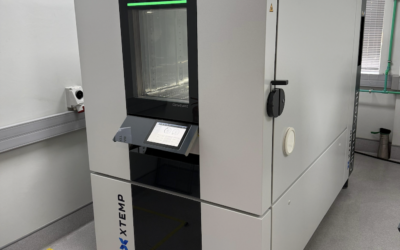
What Is a Thermal Shock Test Chamber?
A thermal shock test chamber is a specialised device designed to subject products to rapid temperature changes. It simulates the stressful conditions that products might experience in real-world environments—such as moving from a hot outdoor setting into a cold indoor one or vice versa—helping to identify potential failures before they occur in the field.

How Does a Thermal Shock Test Chamber Work?
The operation of a thermal shock chamber involves several key steps:
- Temperature Cycling:
The chamber rapidly alternates between high and low temperature zones. The product is moved or transferred between these zones using automated mechanisms or dual chambers connected by a transfer system. - Rapid Temperature Changes:
The chamber is equipped with heating and cooling systems—such as refrigeration units, heating elements, and sometimes liquid nitrogen—to achieve quick and controlled temperature transitions. - Transfer Process:
The test item is quickly moved from the hot environment to the cold environment (or vice versa), mimicking real-world thermal shocks. The transfer time is minimized to ensure the temperature change occurs rapidly. - Monitoring and Data Logging:
Sensors track temperature and other parameters throughout the process. Data loggers record the cycle details to analyze the product’s response over multiple cycles. - Controlled Environment:
The entire process occurs in a precisely controlled environment, ensuring consistent and repeatable testing conditions.

Why Are Thermal Shock Tests and Chambers So Important?
- Ensuring Reliability:
Devices and components often face sudden temperature fluctuations in operation. Thermal shock testing helps verify their durability and identify weak points. - Preventing Failures:
By simulating extreme conditions, manufacturers can detect potential failures such as cracking, delamination, or electrical malfunctions that could occur in the field. - Compliance and Certification:
Many industries, such as aerospace, automotive, and electronics, require thermal shock testing as part of their product validation and certification processes. - Improving Product Design:
The insights gained from testing are invaluable for engineers to improve product materials, design, and manufacturing processes. - Cost Savings:
Identifying issues early reduces warranty costs and product recalls, saving money and protecting brand reputation.
Key Standards for Thermal Shock Testing
- IEC 60068-2-14 – Environmental Testing – Part 2-14: Tests – Combined Heating and Cycling (Thermal Shock Test)
International standard covering procedures for performing thermal shock tests on electronic and electrical components. - MIL-STD-202 – Test Method Standard for Electronic and Electrical Component Parts
Includes methods for thermal shock testing applicable to military electronic components. - JEDEC JESD22-A104 – Thermal Shock Test Method for Electronic Devices
Industry standard used primarily in the semiconductor industry for testing device durability under thermal shock. - IEC 60749-32 – Semiconductor Devices – Mechanical and Environmental Tests – Thermal Shock
Standard focused on testing semiconductor components against thermal shock stress. - MIL-STD-883 – Test Method Standard for Microelectronic Devices
Includes thermal shock testing procedures relevant for microelectronics used in military and aerospace applications. - GB/T 2423.4 – Environmental Testing – Part 2: Tests – Test Db: Damp Heat, Cyclic (Thermal Shock)
Chinese standard aligned with IEC and used in international and Chinese manufacturing. - ASTM D6823 – Standard Guide for Thermal Shock Resistance Testing of Electronic Assemblies
Provides guidance for assessing the thermal shock resistance of electronic assemblies. - ISO 16750-4 – Road Vehicles – Environmental Conditions and Testing
Includes thermal shock testing requirements relevant to automotive components.