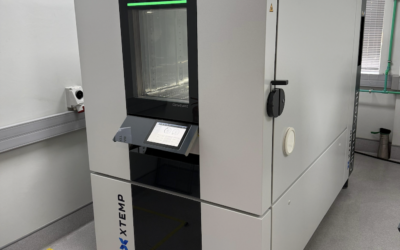
Client: NewSpace Systems (NSS) — Somerset West, South Africa System: IMV A22 ECO Electrodynamic Shaker | Centrotecnica RT450 Slip Table | Vibration Research VR10508 Controller Application: Spacecraft component vibration qualification to ECSS standards Sector: Space & Aerospace
The Client: NewSpace Systems
When it comes to South African engineering excellence on a global stage, few companies match the credentials of NewSpace Systems.
Founded in 2013 and headquartered in South Africa, NewSpace Systems (NSS) is a multinational manufacturer of spacecraft components and sub-systems with branches in North America, Europe, and Oceania. As leaders in Guidance, Navigation and Control (GNC) technology — the systems that tell a satellite where it is, where it is pointing, and how to manoeuvre — NSS has established itself as the largest exporter of spacecraft-utilised hardware on the African continent.
The numbers are striking. NSS products have flown on more than 2,000 spacecraft. They export to over 33 countries across 6 continents. They supply the majority of the world’s commercial spacecraft manufacturers, including blue-chip companies and satellite constellation builders operating fleets of 500 or more satellites. Their engineers work to ESA-accredited standards, following ECSS methodology, and manufacture in ISO-certified cleanrooms.
When a company like NewSpace Systems selects a vibration test partner, they are not choosing casually. Every component they manufacture will eventually be subjected to the brutal mechanical stress of a rocket launch — and must then function flawlessly in the thermal extremes of orbit. Their testing infrastructure has to match that standard precisely.
They chose XTEMP.

The Challenge: Precision Vibration Testing in a Cleanroom Environment
NSS faced a testing challenge that is unique to spacecraft component manufacturers, and one that eliminates most conventional vibration testing solutions before they are even considered.
Their components must be tested to the rigorous vibration qualification requirements of ECSS-E-ST-10-03 — the European Cooperation for Space Standardisation’s structural testing standard — as well as NASA GEVS (General Environmental Verification Standard) for customers operating under NASA requirements. These standards demand high-force, broad-frequency vibration across sine, random, and shock test profiles, with precise control and full data traceability throughout.
But there was a critical complication. NSS manufactures in an ISO-certified cleanroom. The integrity of that environment is non-negotiable — contamination of a spacecraft component is not a quality problem that can be reworked away. It is a mission failure.
Traditional vibration test setups pose a direct threat to cleanroom environments. Conventional air-cooled shaker systems exhaust heated air into the room, introduce particulates through their cooling airflow, and can disturb the controlled air circulation that cleanroom classification depends on. Most electrodynamic shakers are designed for test labs, not for cleanrooms.
Additionally, many of NSS’s components — reaction wheels, magnetorquer rods, sun sensors, magnetometers — needed to be tested in their horizontal orientation without being repositioned or reoriented between axes. For sensitive inertial components, this is not a preference. It is a test validity requirement. Rotating a component to change test axis can introduce stress that contaminates the results.
The requirement was clear and specific: a high-force vibration test system capable of ECSS and NASA GEVS qualification profiles, compatible with cleanroom operation, with horizontal axis testing capability, and with a control system sophisticated enough to handle complex aerospace test profiles. It also had to integrate seamlessly into an operating manufacturing environment without disrupting production.

The Solution: IMV A22 ECO + Centrotecnica Slip Table + Vibration Research Control
XTEMP’s engineering team designed a complete, integrated vibration test system addressing every element of the NewSpace Systems brief.
IMV A22 ECO Electrodynamic Shaker — The Core System
The heart of the installation is the IMV A22 ECO air-cooled electrodynamic shaker — a system that delivers 22 kN of sine and random force with a shock capability of 44 kN, across a frequency range of 0 to 3,300 Hz. With a maximum payload capacity of 300 kg and a displacement of 51 mm peak-to-peak in sine mode, the A22 covers the full spectrum of spacecraft component sizes and qualification profiles that NSS requires.
What sets the IMV A22 apart for a cleanroom application is its concentrated suction cooling system — a design that is fundamentally different from conventional forced-air cooled shakers. Rather than blowing cooling air outward into the test environment, the system draws air inward through a concentrated suction channel. This means the shaker’s thermal management operates entirely independently of the cleanroom’s controlled air circulation. No particulate-laden exhaust enters the test space. No pressure differential disrupts the room’s classification. The A22 cools itself without compromising the environment it operates in.
The ECO system goes further. It continuously monitors the force required for the current test and uses high-frequency power converters to automatically adjust both the field power supply and the cooling blower speed to operate at the point of minimum energy consumption. For NSS, this means lower operating costs and — critically — a dramatically quieter system for the majority of test profiles, without any loss of performance at full rated force.
Centrotecnica RT450 Rail-Guided Slip Table — Horizontal Axis Testing
For components that must be tested horizontally without changing their orientation, XTEMP integrated the Centrotecnica RT450 rail-guided slip table. This precision-engineered slip table allows the A22 shaker’s vertical excitation force to be translated into controlled horizontal axis vibration — smoothly and accurately guiding the test specimen along the horizontal plane with the precision that sensitive spacecraft components demand.
The rail-guided design eliminates the lateral play and oil-film variability that can affect conventional hydrostatic slip tables at low frequencies — a particularly important characteristic for the low-frequency, high-displacement sine sweep tests that spacecraft qualification standards require. For NSS’s reaction wheels and attitude control components, where test result accuracy is directly linked to the reliability of hardware that must maintain satellite pointing in orbit, this precision is not optional.
Vibration Research VR10508 Controller and VibrationView Software — The Brain of the System
Control system selection is as critical as shaker selection for an aerospace application. XTEMP specified the Vibration Research VR10508 8-channel controller paired with VibrationView software — a combination that gives the NewSpace Systems test engineering team complete command over every parameter of the test process.
VibrationView provides rapid test profile creation from pre-defined templates conforming to the international test standards NSS works to — including sine sweep, random vibration, classical shock, and SRS (shock response spectrum) profiles. The 8-channel capability allows simultaneous multi-point control and measurement, essential for larger test articles where response uniformity across the component must be monitored and documented.
For NSS’s quality and certification requirements, the full data traceability provided by VibrationView — test definition, run history, response data, pass/fail criteria, and exported reports — meets the documentation standards required for ECSS-compliant qualification testing.

Installation: A Collaborative Process
The installation required close coordination between XTEMP’s technical team and the NewSpace Systems engineering staff — not only to achieve the mechanical and electrical integration of the three-component system, but to do so without disrupting active cleanroom manufacturing operations.
XTEMP managed the full installation process: mechanical assembly and alignment of the shaker and slip table, electrical integration of the power amplifier and controller, cleanroom compatibility verification of the cooling system, software configuration of the VibrationView test environment, and comprehensive operator training for the NSS engineering team.
The training objective was not simply to show the team how to press run. It was to ensure that NSS engineers understood the system deeply enough to create, modify, and execute their own test profiles confidently — without depending on external support for every new test programme. The result is a system that is genuinely in the hands of the NSS team, not managed remotely by a vendor.
This is the second vibration test system XTEMP has installed at NewSpace Systems. The first installation — an IMV A65 shaker with a 1g Dynamics HBT750 slip table and head expander — delivered the higher-force capability required for larger spacecraft sub-system testing. The A22 system extends that capability to higher-frequency, lower-mass component qualification in the cleanroom environment. A client who comes back for a second system is not a satisfied customer. They are a convinced one.
Even the best hardware needs a brilliant brain. That’s why we incorporated Vibration Research’s advanced control system, featuring the intuitive VibrationView software and the powerful VR10508 8-channel controller. This system offers Newspace engineers unprecedented control over the testing process, allowing them to easily create and execute a wide variety of complex test profiles.

The Result: A Qualification-Grade Test Capability, In-House
NewSpace Systems can now perform the full range of spacecraft component vibration qualification testing in-house, in their cleanroom, without the delays, costs, and logistics complexity of outsourcing to external test facilities.
The integrated system delivers:
- Sine, random, and classical shock testing to ECSS-E-ST-10-03 and NASA GEVS requirements
- Horizontal axis testing without component reorientation — maintaining test validity for sensitive inertial components
- Cleanroom compatibility — the IMV A22 ECO cooling system operates independently of cleanroom air circulation, preserving ISO classification
- Full test data traceability — VibrationView documentation meets ECSS audit and certification requirements
- Energy-efficient, low-noise operation — the ECO system runs quietly and efficiently for the majority of test profiles
- In-house operator capability — NSS engineers were trained to full operational independence on the system
For an organisation whose products fly on more than 2,000 spacecraft and whose customers include the builders of the world’s largest commercial satellite constellations, the ability to perform rigorous, standards-compliant vibration qualification in-house — in their own cleanroom, on their own schedule — is a direct competitive advantage.

IMV’s ECO-shaker system constantly monitors the force required to operate the vibration test and by using the high frequency power converters discussed above, the ECO-system automatically adjusts the field power and cooling blower speed to run at the point of minimum energy consumption. Not only does this save energy, but it also means that for most tests, the ECO-system is quiet. Air-cooled shaker systems are sometimes criticised for the level of blower noise, but IMV’s ECO-system solves this problem.

Could Your Facility Benefit from a Similar Solution?
If your organisation designs, manufactures, or qualifies components for aerospace, space, defence, or any application where vibration testing to international standards is required, XTEMP can help you specify and install the right system.
We supply and support IMV electrodynamic shakers across the full force range, slip tables, combined vibration and climatic systems, and Vibration Research control systems — backed by 15 years of specialist expertise and local support in Pretoria and Cape Town.
Contact XTEMP to discuss your vibration testing requirements:
📞 Pretoria: +27 12 443 6565 📞 Cape Town: +27 21 974 6227 📧 info@xtemp.co.za 🌐 www.xtemp.co.za

A-Series Vibration Shaker
Medium Force Vibration Shaker system
Air-Cooled Electrodynamic Shaker for of a wide range of tests requirements for a versatile testing environment.
from 11kN to 74kN